pacod demo
pacod-demo · demo.pacod.io

The whole pacod stack, working as one platform.

Identity, the AI gateway, the agent platform, the CMS and the knowledge base: five open-source projects behind one address, one sign-in for all of them, and every model call through one gateway.

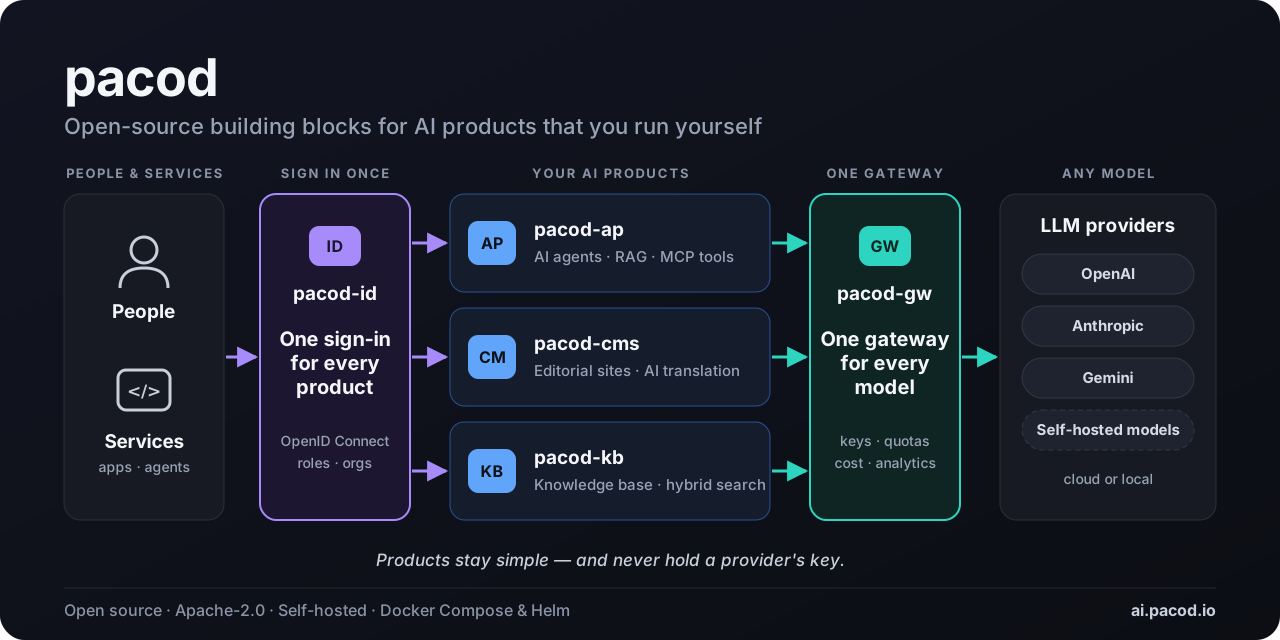
People and services sign in once through pacod-id, use AI products built on pacod-ap, pacod-cms and pacod-kb, and every model call goes through pacod-gw to any LLM provider
pacod22, the organisation's profile: the overview of all five projects, at ai.pacod.io and github.com/pacod22.
IDpacod-id GWpacod-gw APpacod-ap CMpacod-cms KBpacod-kb

The products

Each is a complete product with its own repository; here they share one network, one database server and one sign-in.

ID

pacod-id

Identity & access

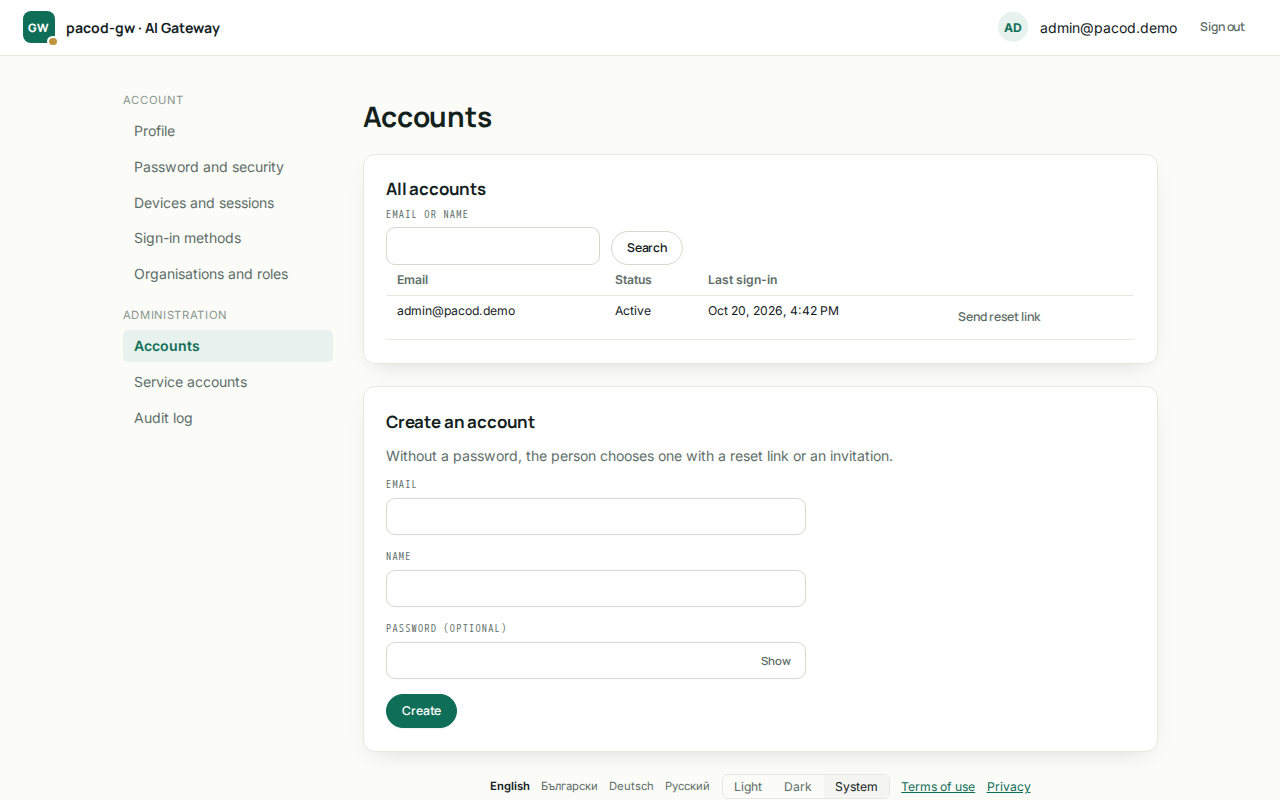
One place where people and machines sign in, and where it is recorded what they may do. An OpenID Connect provider for first-party applications: accounts, organisations, role bindings, and a change feed that products follow to decide access locally.

In the demo it is the one realm every product signs in with.

  • Rust
  • axum
  • PostgreSQL
  • OpenID Connect
  • SvelteKit
GW

pacod-gw

AI gateway

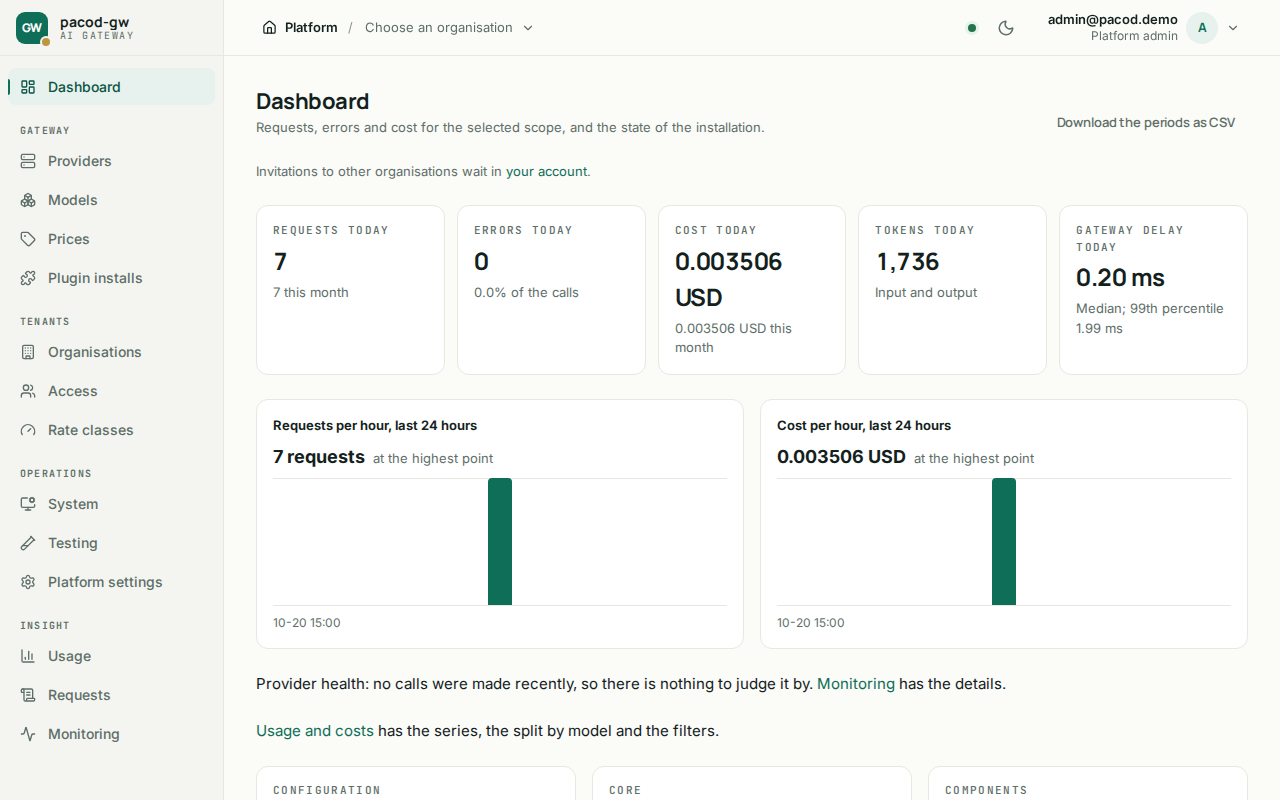
Sits between applications and LLM providers. A Rust core relays or translates every call (OpenAI, Anthropic and Gemini formats), keeps provider keys out of the apps, enforces quotas, prices each request and streams usage into ClickHouse, managed from a SvelteKit console.

In the demo every product's model calls go through it; with no provider key set, its mock provider answers.

  • Rust
  • PostgreSQL
  • ClickHouse
  • SvelteKit
AP

pacod-ap

Agent-building platform

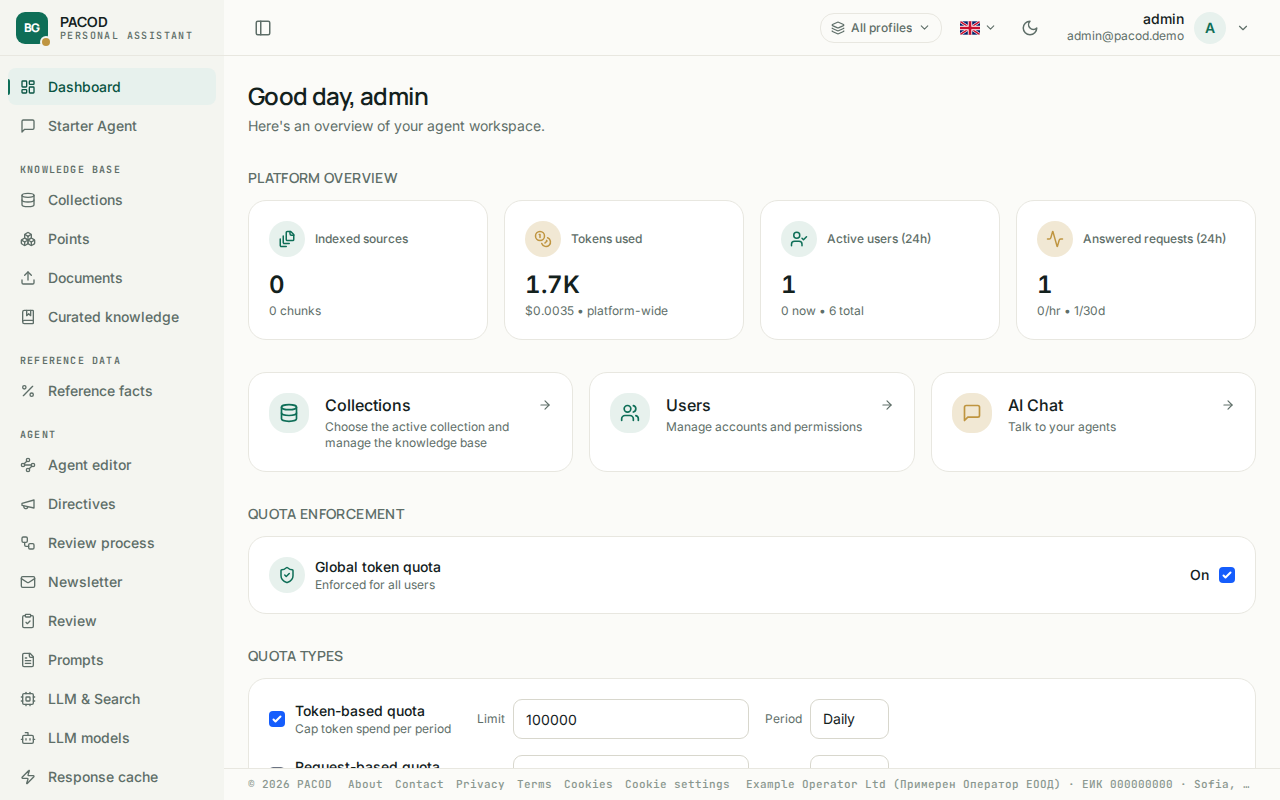
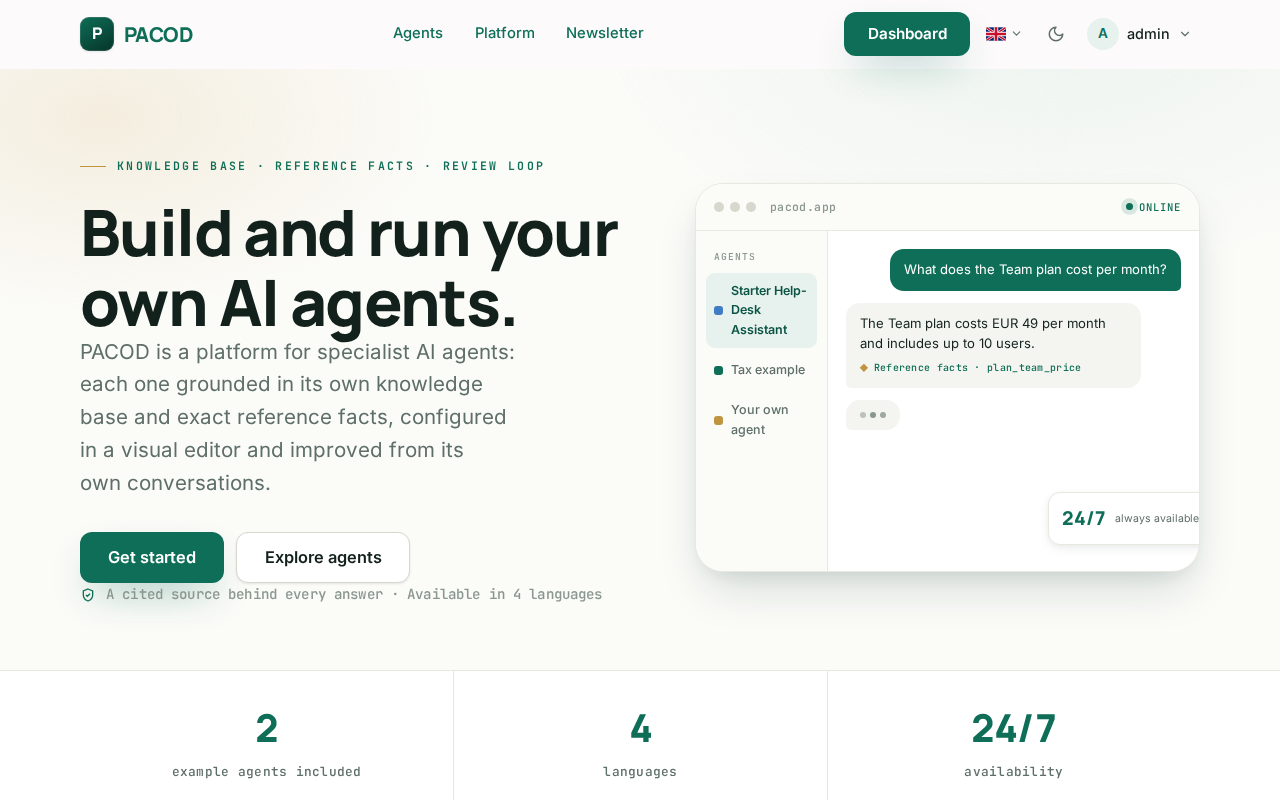
Any number of self-contained AI agents on one deployment. Each agent has its own knowledge base, reference facts, prompts, directives, conversations and reviews, behind one sign-in and one admin console, with a review loop that improves every agent.

The demo runs the starter agent, a small fictional help desk.

  • FastAPI
  • LangGraph
  • MCP
  • SvelteKit
  • PostgreSQL
  • Redis
  • Qdrant
CM

pacod-cms

Content management

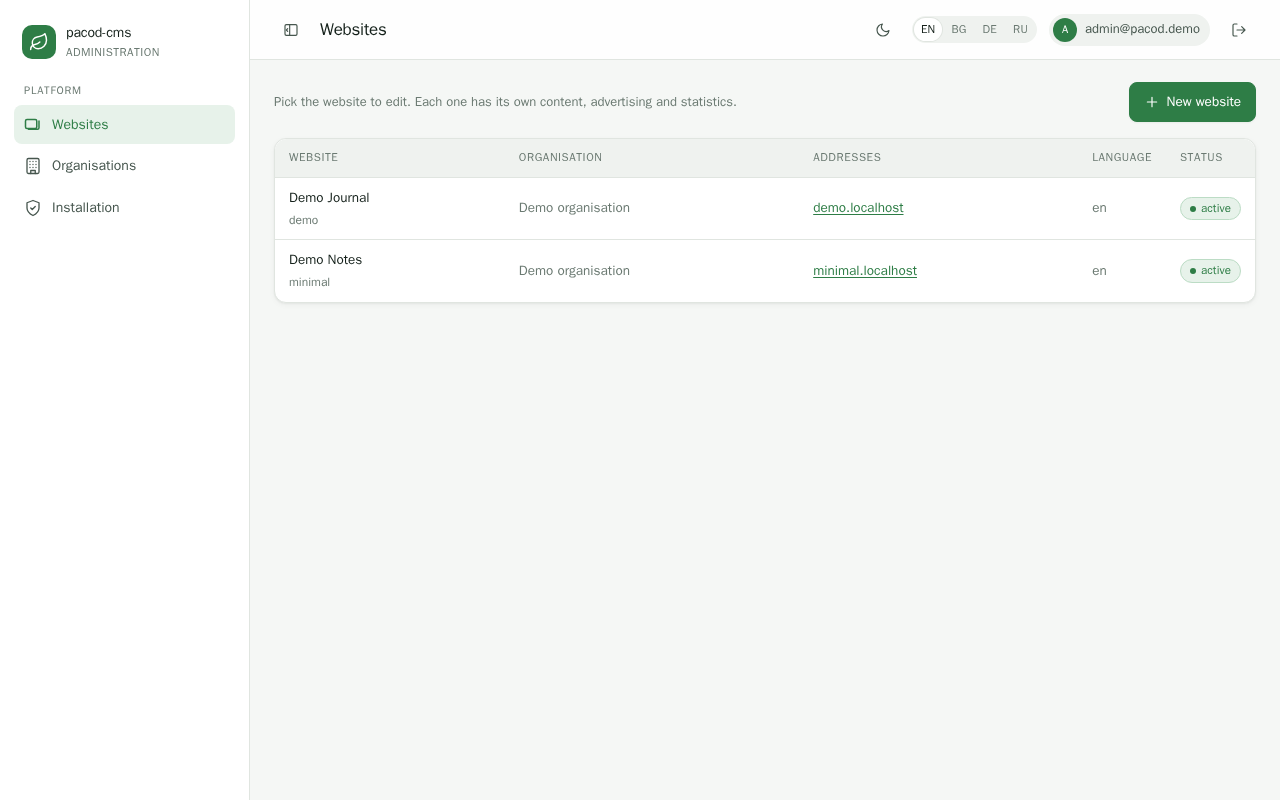
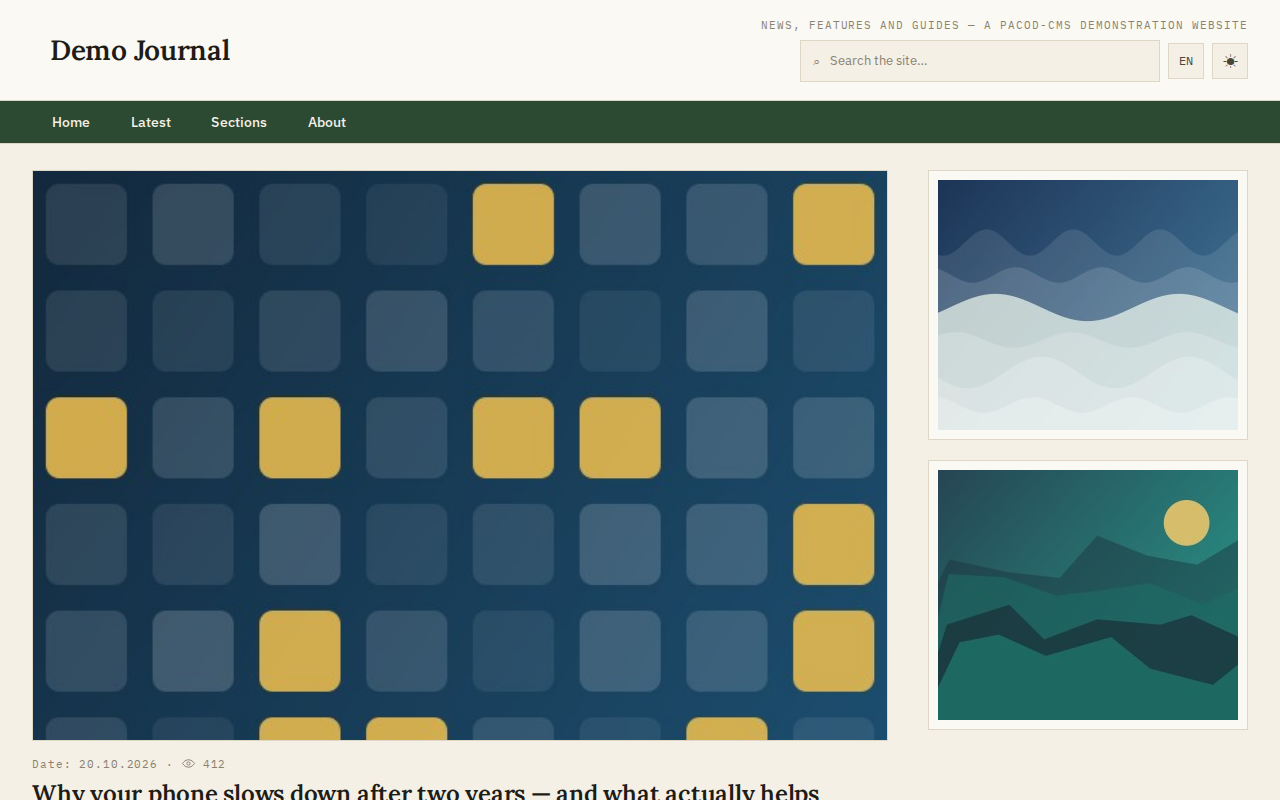
A CMS for editorial websites: articles, authors and categories, standing pages, an image library, advertising with an HTML5 banner builder, PDFs and journal issues, statistics, and multilingual content with AI translation. One installation hosts many websites, each with its own database, files and cache.

The demo has two websites: Demo Journal and Demo Notes.

  • Java 25
  • Spring Boot
  • Thymeleaf
  • MongoDB
  • Gotenberg
KB

pacod-kb

RAG knowledge base

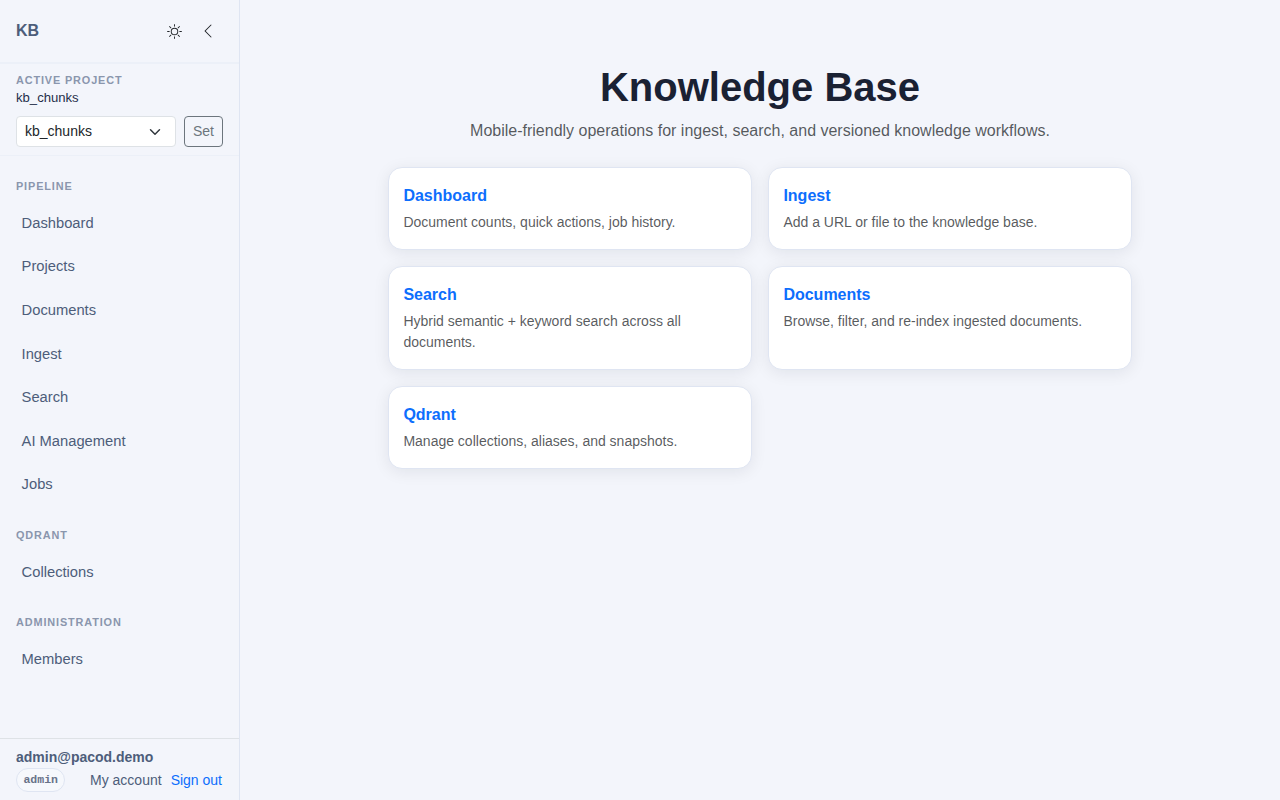
A document knowledge base for retrieval-augmented generation: it ingests files and web pages, converts them to canonical Markdown, indexes them for hybrid semantic and keyword search, keeps every version, and hands models chunks with a stable metadata contract. CPU only, with built-in prompt-injection defence.

  • FastAPI
  • Qdrant
  • BGE-M3
  • BM25
  • HTMX

How they fit together

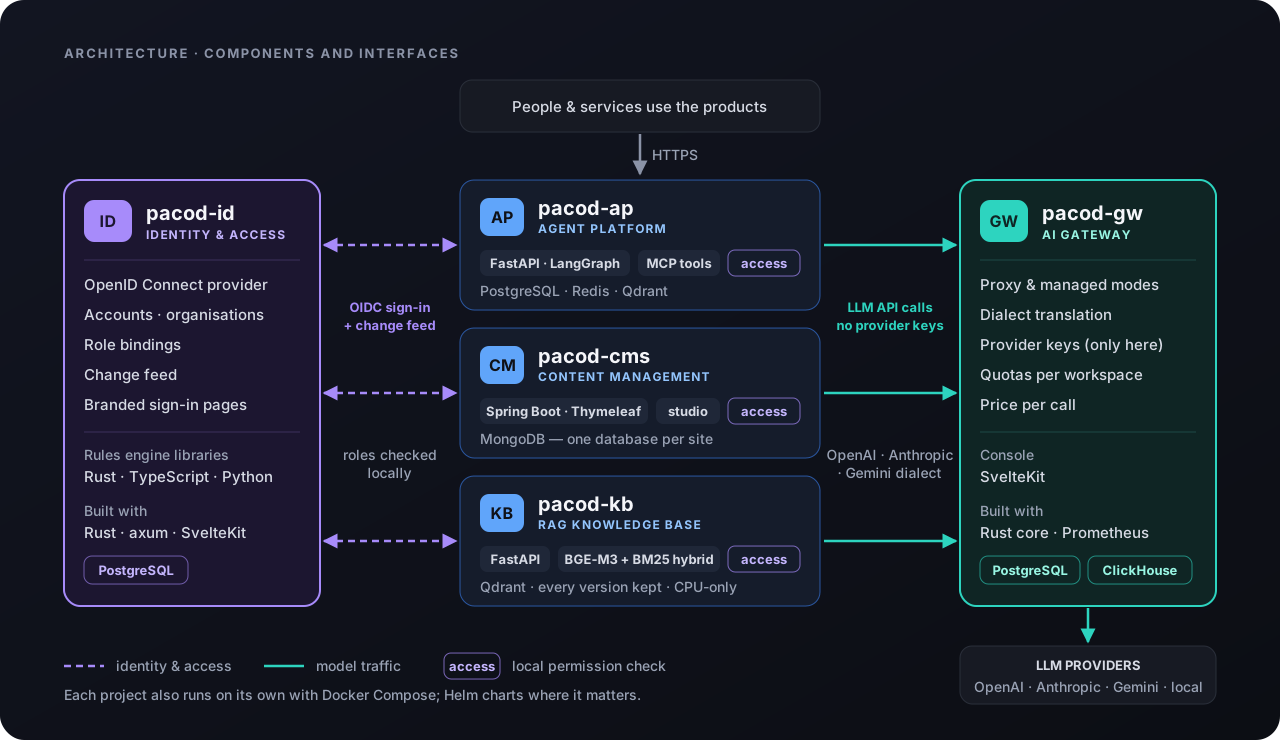
Every person signs in through pacod-id; every model call goes through pacod-gw. The products on top never hold a provider's key.

Architecture: people and services sign in through pacod-id, which provides identity and roles to pacod-ap, pacod-cms and pacod-kb; every LLM call from these products goes through pacod-gw to the LLM providers
# in pacod-demo/
make urls      # the addresses and the admin's password
make verify    # check that everything works together
make shots     # retake this page's screenshots
make down      # stop; the data stays